Is AI Killing Entry-Level IT Jobs in 2026? Here Is What the Data Actually Shows
"AI is taking all the jobs" is one line. "AI has grown IT employment for a decade" is another. Both get repeated constantly, and both are missing the real pattern. Using payroll data, government projections and hiring-platform numbers, this is the honest picture of AI and entry-level IT jobs in 2026, and what freshers can actually do about it.
The short answer
- AI is not mainly firing junior developers. It is making companies hire fewer of them. The effect shows up in reduced new hiring, not mass layoffs of people already employed.
- Experienced developers are largely unaffected, and in some data sets their employment is growing.
- Total software developer jobs are still projected to grow strongly through 2034. The entry point is what has narrowed, not the profession.
- Specialties tied directly to AI, cloud and security are hiring aggressively, even as general "developer" postings shrink.
The clearest evidence: Stanford payroll data
The most credible research so far comes from the Stanford Digital Economy Lab's "Canaries in the Coal Mine" project, which used actual ADP payroll records instead of job-board postings or surveys. An August 2026 revision found employment of workers aged 22 to 25 in AI-exposed occupations sitting 19% below where it would be had it tracked less-exposed peers, up from a 13% gap a year earlier. A separate summary of the same research line describes software developers aged 22-25 down nearly 20% from their late-2022 peak, while workers 30 and over in the same fields saw employment grow 6-12% over the same period.
The mechanism the researchers describe is important: the decline runs through reduced hiring, not increased layoffs, and it is concentrated in applications where AI automates a task end-to-end, not where it merely assists a human doing the work.
How much of 2026's layoffs are really "AI"
AI was cited as the number one stated reason for US layoffs for five consecutive months in 2026, per Challenger, Gray & Christmas data reported by Uvik Software, and AI was cited in 87,714 announced job cuts through May 2026, about 22% of total announced layoffs. But industry analysis cautions that many "AI-driven" layoff announcements describe generalist roles that AI tooling made easier to consolidate, rather than an AI specialist losing a seat. In other words, AI is often the stated reason, and sometimes the real cause, but not always the whole story.
What is happening to hiring, role by role
| Segment | 2026 trend | Source |
|---|---|---|
| Overall software development postings | Down 36.4% vs Feb 2020 baseline; down 6.7% year over year as of Oct 2025 | Indeed Hiring Lab |
| Entry-level postings | Down roughly 28% from their 2022 peak | Indeed Hiring Lab |
| Senior postings | Up 13.5% from January 2025; drove 71% of the developer posting rebound from May 2025-May 2026 | Indeed Hiring Lab |
| Machine learning / AI engineer postings | Up 59% (ML) and up 85% year over year (AI/ML broadly) | Indeed Hiring Lab |
| New-grad hiring at large tech firms | Down roughly 50-65% versus 2019 | SignalFire, 2026 |
| New-grad hiring at early-stage startups | Down about 76% | SignalFire, 2026 |
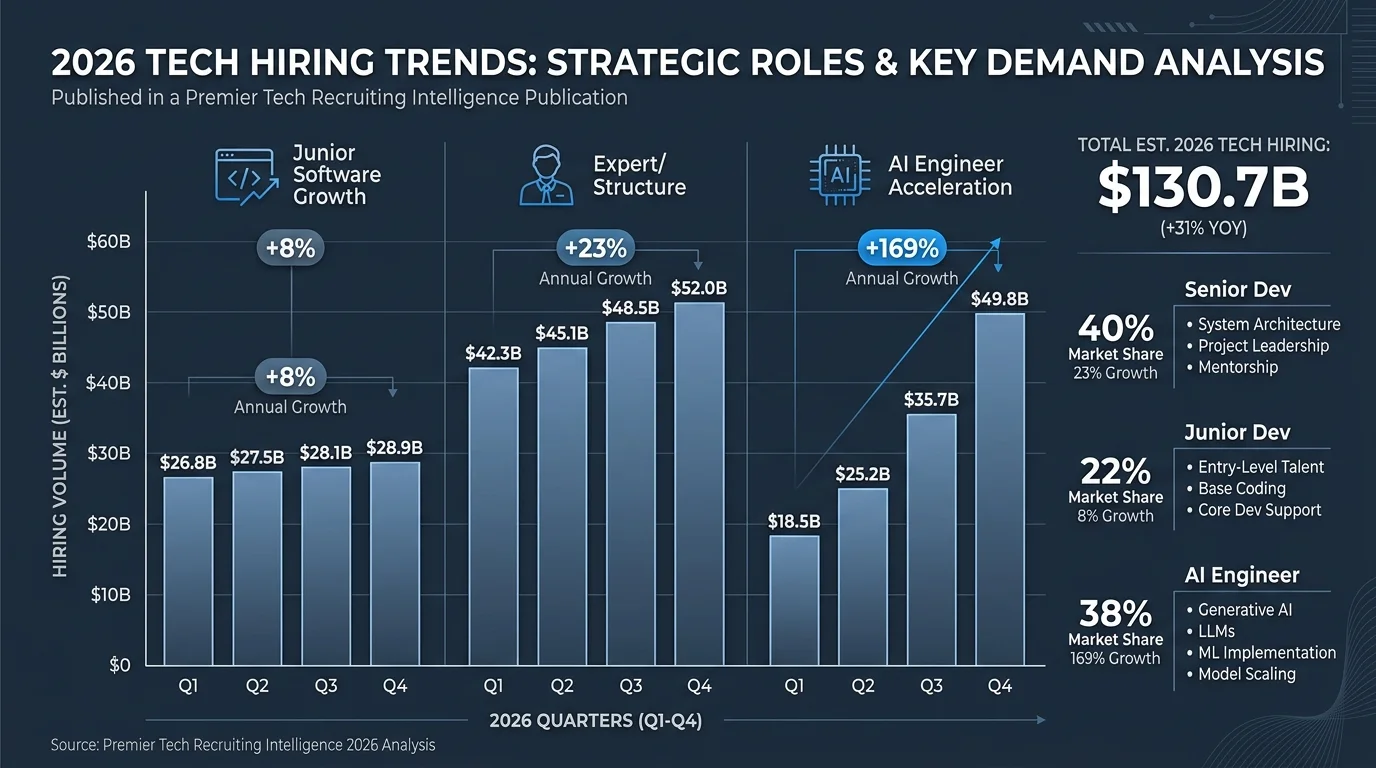
The pattern is consistent everywhere it is measured: fewer junior seats, more senior and AI-specialist seats, and a market that rewards people who can already do the work rather than people being trained into it.
Where jobs are actually growing
Zoom out and the long-term picture is not bleak. The US Bureau of Labor Statistics still projects software developer employment to grow about 15-16% from 2024 to 2034, adding roughly 267,700 jobs, far faster than the average occupation. A separate BLS-based estimate expects about 129,200 annual openings for developers, QA analysts and testers through 2034.
Workers who combine multiple AI skills earn a salary premium estimated near 43% above non-AI counterparts, according to pay studies cited by Acceler8 Talent. Pairing foundational coding with the highest-paying IT certifications in 2026 (such as AWS, GCP, or DevSecOps) gives early-career talent a proven way to pass screening filters. That premium, plus the hiring data above, points to the same conclusion: AI fluency has become the new baseline qualification, not an optional extra. For the wider hiring picture, see our US IT recruitment market 2026 guide.
What freshers should do differently
- Use AI tools openly and well. Employers are not looking for people who avoid AI; they want people who use it to ship faster and still understand the code.
- Build a portfolio, not just a resume. Real projects, GitHub commits and deployed apps now matter more than a degree alone.
- Go deep in one growth area such as AI/ML tooling, cloud, data engineering or cybersecurity instead of staying a broad generalist.
- Target smaller and mid-size companies and staffing-partner-sourced roles, where hiring is less concentrated on big-tech new-grad programs.
- Apply through referrals and recruiters rather than relying only on online applications, since junior roles get fewer postings but the ones that exist are more competitive.
- Be patient with timelines. A longer job search is now common for freshers; plan your finances and visa runway (if relevant) accordingly. See our H-1B 2026 update if you are on OPT or STEM OPT, and learn contract tax models in our C2C vs W2 guide.
Note for employers and recruiters
The data suggests a talent-pipeline risk: if companies stop hiring and training juniors now, the senior engineers of 2032 will not exist. Employers who keep even a small junior intake, paired with AI-assisted mentoring, may build a real hiring advantage once the market normalizes. Recruiters should screen for demonstrated project work and AI tool fluency rather than years of experience alone when evaluating entry-level candidates.
60+ active direct-client requisitions. C2C, W2 and 1099 accepted.
View Open Jobs
Frequently asked questions
Is AI really taking entry-level developer jobs in 2026?
Stanford payroll research found employment for developers aged 22-25 about 19% below trend as of August 2026, driven mainly by reduced new hiring rather than layoffs of existing juniors. Experienced developers show no comparable decline.
Are AI layoffs the main cause of 2026 tech job cuts?
AI was the top stated reason for US layoffs for five straight months in 2026, but AI-cited cuts are about 22% of total announced layoffs, so many "AI" layoffs also reflect broader restructuring.
Will software developer jobs keep growing despite AI?
Yes, in aggregate. The BLS projects roughly 15-16% growth from 2024 to 2034, even as entry-level hiring specifically contracts.
How can a fresher get an IT job in 2026 despite AI?
Build a visible project portfolio, get fluent with AI coding tools, specialize in a growth area like AI, cloud or security, and use referrals and staffing partners instead of relying only on online applications.
Final thoughts
AI has not ended entry-level IT careers, but it has changed the entry price. Freshers who show real, AI-assisted output and pick a growth specialty are still getting hired. Employers who keep investing in juniors now are quietly building an edge for later. Browse open IT roles or read our India vs USA IT jobs comparison for the bigger career picture.
Related Career & Staffing Guides
10 Highest-Paying IT Certifications in 2026
Cloud, security and AI credentials commanding $150K-$221K with cost and ROI analysis.
Market ReportUS IT Recruitment Market 2026: Trends & Salaries
Tech unemployment at 2.9%, AI and cybersecurity demand surges, and hiring speed strategies.
Work AuthorizationH-1B 2026 Update: Lottery & IT Visa Options
Wage-weighted lottery, STEM OPT, GC EAD, and top compliance rules for IT consultants.
Career StrategyIndia vs USA IT Jobs 2026 Comparison
Real salary gap, taxes, living costs, GCCs, and remote USD-denominated contracts.
Sources: Stanford Digital Economy Lab ("Canaries in the Coal Mine," August 2026 revision) via SentiSight.ai and Mothasa; Indeed Hiring Lab data via Pin.com, SQ Magazine and Uvik Software; U.S. Bureau of Labor Statistics; SignalFire 2026; Challenger, Gray & Christmas; Layoffs.fyi; Acceler8 Talent. Figures reflect publicly reported data as of September 2026 and may change as new data is released.