US IT Recruitment Market 2026: What's Changing and How to Win

The US IT recruitment market in 2026 is a story of two speeds. Overall tech hiring is warming up after a rough stretch, yet the roles employers fight hardest for, such as AI, cybersecurity and cloud, are moving much faster than the rest. If you hire IT talent or you are an IT professional looking for your next contract, this guide shows what the numbers say and what to do about them.
The 2026 market snapshot
Early 2026 was slow and cautious. By summer, the picture improved. CompTIA's analysis put tech occupation unemployment at 2.9% in June 2026, its lowest reading of the year and far below the national rate of roughly 4.2%. Employers posted around 280,000 new tech listings that month and kept more than 600,000 tech roles open. Dice reports that several large companies have told investors they plan to resume hiring.
Two markets in one
Headlines that say "tech is booming" and "tech is dead" are both half right. According to a 2026 market report citing Indeed Hiring Lab data, overall tech postings remained about 36% below their February 2020 level, while machine learning engineer openings were up 59% and general software engineering postings were down around 49% (the Indeed figures date from mid-2025, so treat them as directional).
For recruiters, that means you are sourcing in two markets at once: a crowded, price-sensitive pool of generalists, and a scarce, expensive pool of AI, security and cloud specialists.
Most in-demand IT roles in 2026
Robert Half links current demand to AI adoption, security threats and infrastructure modernization. In practice, these are the roles we see requisitions clustered around:
- AI / ML engineers building and deploying models, plus AI-fluent developers.
- Cybersecurity engineers and analysts, including cloud security and DevSecOps.
- Cloud and platform engineers (AWS, Azure, GCP, Kubernetes).
- Data engineers and analysts supporting analytics and AI pipelines.
- Full stack and backend developers with modern frameworks and API experience.
- Systems and network architects for modernization and hybrid environments.
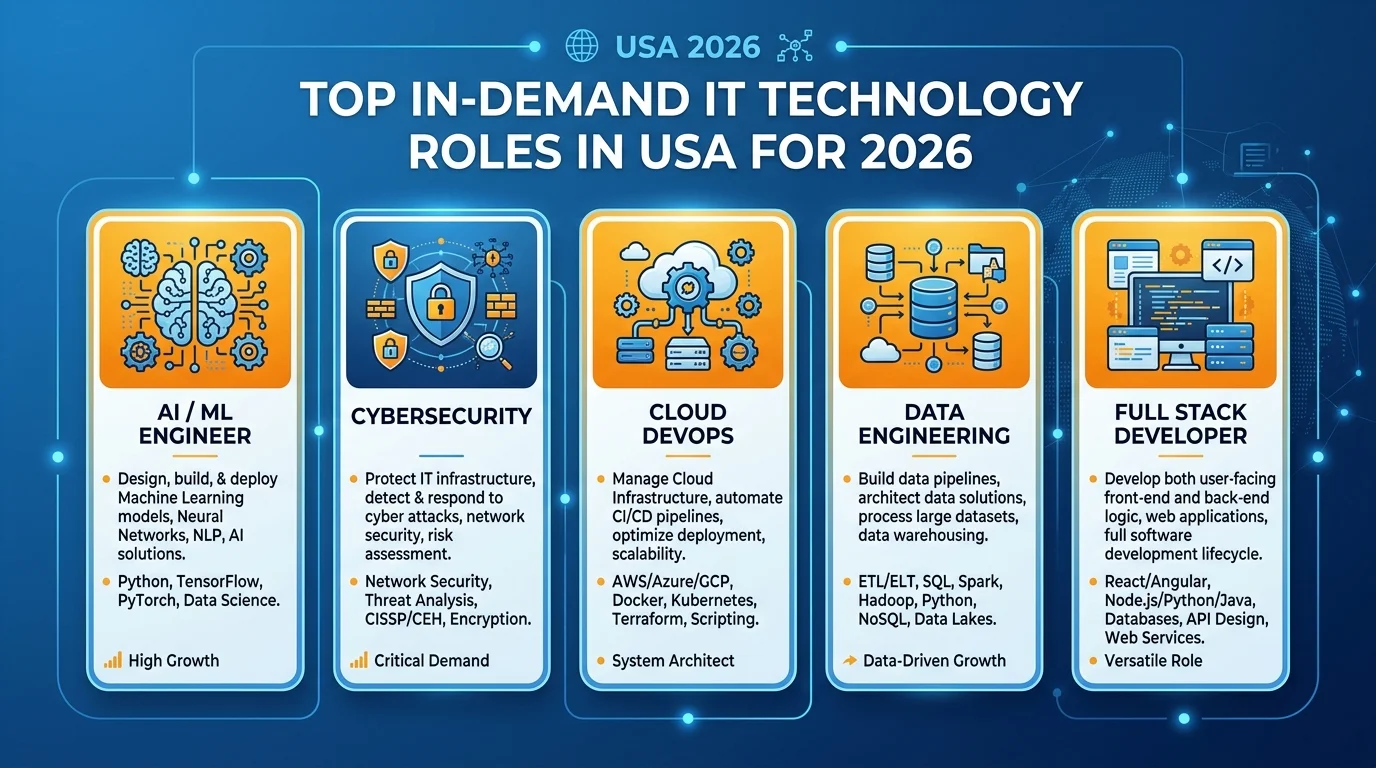
Long-term, the CompTIA workforce projection expects US tech jobs to grow from about 6.09 million in 2025 to 7.03 million by 2035, led by data and cybersecurity roles.
Salary and pay trends
The Bureau of Labor Statistics reported a median annual wage of $105,990 for computer and IT occupations in 2024, roughly double the median for all US jobs. Addison Group's 2026 guide projects salary growth of about 8-10%, with cybersecurity talent earning a further 10-15% premium at mid-level.
| Talent segment | Market pressure | What it means |
|---|---|---|
| AI / ML specialists | Very high | Fast offers, premium pay, multiple competing bids |
| Cybersecurity, cloud security | High | Pay premiums and longer searches |
| Cloud, data engineering | Moderate to high | Steady demand, skills-based screening |
| General software roles | Moderate | More applicants, employers can be selective |
How IT hiring is changing
Skills over tenure
Employers increasingly test what a candidate can do, not just how many years they have. Portfolios, code samples and certifications carry real weight.
Speed decides winners
Extra interview rounds are a common reason strong candidates accept other offers. Compressing the process to a few focused steps is now a competitive advantage.
AI fluency is a baseline
Most tech job descriptions now expect comfort with AI tools, and recruiters use AI to screen, match and schedule. Human judgment still decides culture fit and communication.
Flexible engagement models
Contract and contract-to-hire hiring remain popular because they let companies add capacity without long commitments. If you are weighing engagement types, read our guide on C2C vs W2 vs 1099 IT contracts.
Playbook for employers
- Cut interview steps to what genuinely predicts success, and give decisions within days.
- Write role descriptions around outcomes and must-have skills, not long wish lists.
- Benchmark pay against current data before opening a search for scarce skills.
- Use contract or contract-to-hire for urgent projects, then convert top performers.
- Work with a specialist IT staffing partner that pre-vets candidates and understands technical screening.
Playbook for candidates
- Build depth in one high-demand area (cloud, security, data or AI) and add adjacent skills.
- Show proof: GitHub projects, certifications and quantified results on your resume.
- Keep your resume ATS-friendly with clear job titles, tools and dates.
- Understand your work authorization and contract type options before interviews.
- Respond to recruiters quickly, since good requisitions fill fast.
60+ active direct-client requisitions. C2C, W2 and 1099 accepted.
View Open Jobs
Frequently asked questions
Is the US IT job market good in 2026?
It is improving. Tech unemployment fell to about 2.9% in June 2026 and open tech roles stayed above 600,000. Demand is strongest for AI, cybersecurity, cloud and data skills.
Which IT skills are most in demand in the USA in 2026?
AI and machine learning, cybersecurity, cloud and DevSecOps, data engineering and full stack development, with AI fluency expected across most roles.
Are IT salaries rising in 2026?
Industry guides project roughly 8-10% growth, with higher premiums for scarce specialties like cybersecurity.
Should I choose C2C, W2 or 1099?
It depends on taxes, benefits and risk tolerance. Our contract type comparison walks through each option.
Final thoughts
The 2026 US IT recruitment market rewards speed, clarity and specialization. Employers who move fast and pay fairly win talent, and candidates who build in-demand skills and keep their profiles sharp win better offers. Browse current IT openings or learn how SmartHire works.
Sources: CompTIA data as reported by Metaintro and Dice; Pin tech job market report (citing Indeed Hiring Lab); Robert Half technology hiring research; Addison Group 2026 workforce guide; TechTarget (CompTIA and BLS data); U.S. Bureau of Labor Statistics. Figures reflect the latest published data as of September 2026.