H-1B 2026 Update: Lottery, Fees and the Best Work Visa Options for IT Jobs

If you are an IT professional aiming for a US job, the H-1B 2026 update matters more than any resume tweak. The random lottery is gone, a $100,000 fee was created and then struck down in court, and a new fee has been proposed. Add the fact that the US tech market itself is recovering unevenly (see our US IT recruitment market 2026 guide), and the question becomes: which work authorization path actually works for you?
Quick answer
- H-1B selection has been wage-weighted since February 27, 2026, which favors higher wage levels and hurts entry-level registrations.
- The $100,000 fee was vacated by a federal district court on June 8, 2026 and is on appeal. Its underlying proclamation was scheduled to expire around September 21, 2026 unless extended.
- DHS proposed a $103,265 fee on cap-subject petitions on August 25, 2026. Public comments close September 24.
- Candidates already in the US on OPT or STEM OPT generally have the strongest position because change-of-status filings were not the target of the fee.
2026 timeline: what happened
The wage-weighted lottery
For years, H-1B registrations were drawn at random. Under the current system, registrations at higher Department of Labor wage levels carry proportionally more weight, as this F-1 to H-1B guide notes for the FY 2027 cycle. The annual cap is still 85,000, which includes 20,000 extra slots for US master's graduates.
What this means in practice: senior developers, architects and specialists at higher wage levels see better odds, while entry-level applicants are more likely to face repeated misses. Legal commentary suggests two or three consecutive misses is now a realistic expectation for entry-level roles. That is why the length of your work authorization runway matters so much.
The fee situation
The $100,000 proclamation fee
Introduced in September 2025, it made offshore H-1B hiring very expensive. A federal court in Massachusetts vacated it on June 8, 2026, and the First Circuit declined to pause that ruling on July 24. The government is appealing, and reporting indicates the fee is not currently being collected.
The proposed $103,265 fee
On August 25, 2026, DHS proposed a separate fee of $103,265 on cap-subject petitions, with comments open through September 24. Because this is only a proposal, it is not final. Watch the Federal Register for updates.
Why "already in the US" is a strong position
Analysis from Refolk notes that an F-1 OPT or STEM OPT candidate converting to H-1B inside the US falls outside the fee, while a consular filing for someone abroad does not. Ask your attorney how this applies to your case.
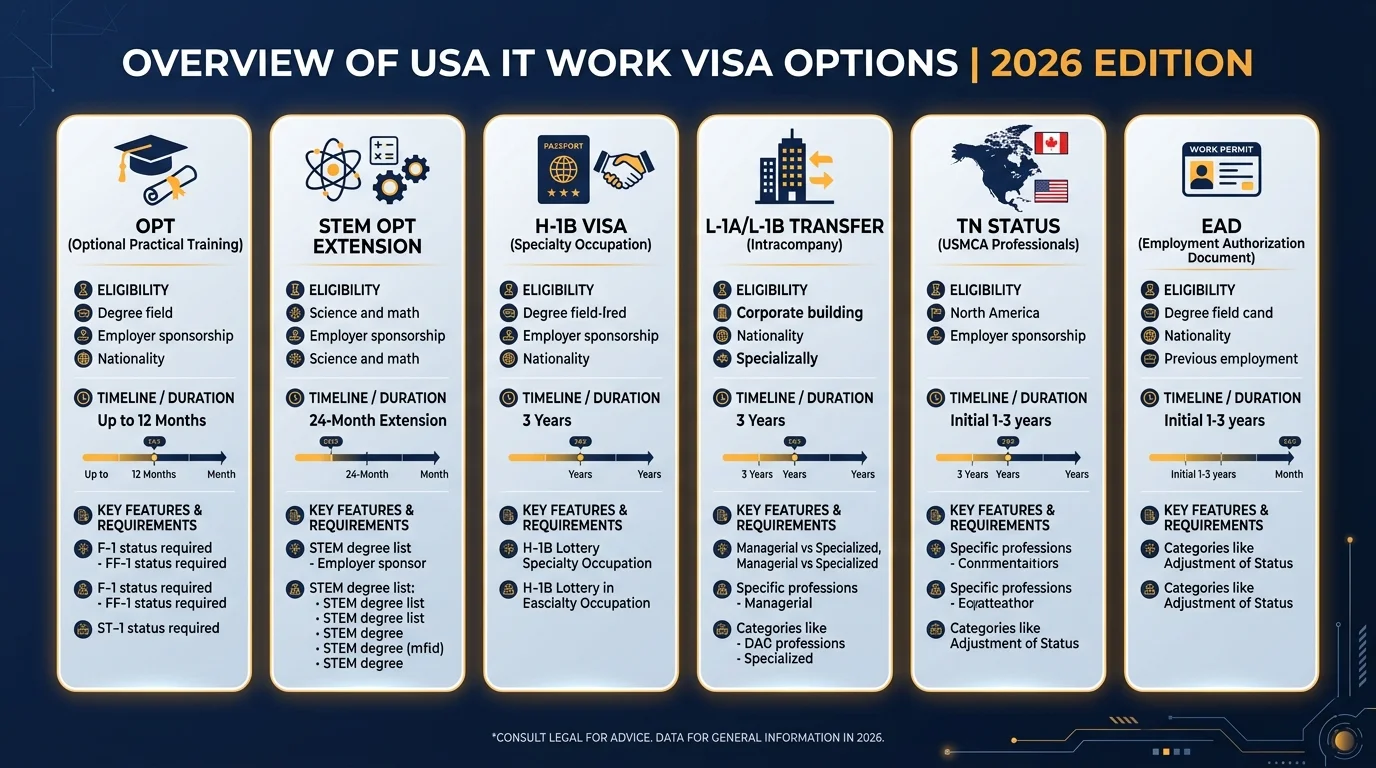
Work authorization options compared
| Option | Who it fits | Main advantage | Main limitation |
|---|---|---|---|
| OPT (12 months) | Recent US graduates on F-1 | Work in a field related to your degree without an H-1B | Short runway; work must relate to your degree |
| STEM OPT (+24 months) | Graduates with eligible STEM degrees | Adds two or three H-1B lottery attempts | Needs an E-Verify employer and a formal training plan, so it is normally employee (W2) work |
| H-1B | Specialty occupation professionals with a sponsor | Up to a 6-year path and a route to a green card | Capped, wage-weighted selection, fee uncertainty |
| L-1 | Staff transferring within a multinational employer | No lottery | Requires prior employment abroad with the same group |
| TN | Eligible Canadian and Mexican citizens in listed professions | Fast, no lottery | Limited to listed occupations and nationalities |
| EAD (H-4, pending green card) | Eligible spouses and green card applicants | Open work authorization with any employer | Depends on the primary applicant's status and processing times |
| Cap-exempt H-1B | Roles at universities, affiliated nonprofits and research organizations | Not subject to the annual cap lottery | Fewer traditional IT employers |
| US citizen / green card holder | Permanent status | No sponsorship required | Not applicable to new arrivals |
Not sure whether to take a W2 role or contract with a C2C or 1099 arrangement? Your status often decides it. Our guide to C2C vs W2 vs 1099 IT contracts explains the trade-offs.
What recruiters check first
When a candidate applies, US IT recruiters screen work authorization early because it decides which requisitions are even possible. Expect these questions:
- What is your current status, and when does it expire?
- Do you need sponsorship now or in the future, and do you need a transfer?
- Are you open to W2 only, or also corp-to-corp (if your status allows)?
- Does the client require E-Verify or restrict certain statuses?
- Are you willing to relocate or work onsite or hybrid?
Action plan for candidates
- Map your runway: count how many H-1B registration cycles your OPT or STEM OPT can cover.
- Target employers that sponsor at higher wage levels and that use E-Verify, especially if you are on STEM OPT.
- Build in-demand skills (cloud, security, data, AI) to qualify for higher wage-level roles.
- Prepare a backup: cap-exempt employers, L-1 routes, or roles abroad with a US-facing team.
- Avoid international travel at sensitive moments, such as before an H-1B change of status takes effect, without attorney advice.
- Keep documents organized: passport, I-94, I-20, EAD, offer letters and pay stubs.
Note for employers
Sourcing from candidates already in the US, including OPT and STEM OPT talent, is the lower-friction route while fees and litigation remain unsettled. Budget for wage levels, since they now affect selection odds, and keep your immigration counsel involved before making offers that depend on sponsorship.
60+ active direct-client requisitions. C2C, W2 and 1099 accepted.
View Open Jobs
Frequently asked questions
Is the H-1B lottery random in 2026?
No. Since February 27, 2026, selection is wage-weighted, giving registrations at higher DOL wage levels more weight than entry-level ones.
Do F-1 OPT students have to pay the $100,000 H-1B fee?
Reporting indicates the fee targeted workers outside the US and did not reach change-of-status cases from F-1. A court also vacated the fee on June 8, 2026, and the case is on appeal, so confirm the latest with an attorney.
How long can I work on STEM OPT?
Eligible STEM graduates can add a 24-month extension to the initial 12 months of OPT, which can give two or three lottery attempts.
What are the best alternatives to H-1B for IT jobs?
OPT and STEM OPT, L-1 transfers, TN status for eligible Canadian and Mexican citizens, EAD-based work authorization, and cap-exempt employers such as universities and research nonprofits.
Where can I check current H-1B rules?
Start with the official USCIS H-1B page, then confirm with a licensed immigration attorney.
Final thoughts
H-1B in 2026 rewards preparation. Build skills that lift your wage level, use your OPT and STEM OPT runway wisely, and keep a backup route ready. Then browse open IT roles and tell the recruiter your status upfront. For the bigger hiring picture, read our US IT recruitment market 2026 analysis.
Sources: Scale.jobs H-1B news roundup; Refolk; Tchern McCallum Immigration Law; VisaVerge; visafortheunitedstates.com; USCIS; DHS Study in the States. Status of court cases, the proclamation and the proposed rule may change after September 19, 2026.