India vs USA IT Jobs 2026: Salary, Taxes, Lifestyle and Career Growth

Every Indian IT professional eventually asks the same question: should I build my career in India or move to the USA? The salary gap looks enormous, but taxes, healthcare, rent, visas and family all change the math. This guide compares India vs USA IT jobs in 2026 on the things that actually matter, so you can decide with numbers instead of hype.
Quick verdict
- Choose the USA if you want the highest absolute earnings, exposure to top product companies, and you can handle visa uncertainty.
- Choose India if you value lower living costs, family proximity, stability and a growing set of high-paying product and GCC roles.
- Consider remote US work from India if you want dollar-linked pay without relocating.
Salary: the headline gap
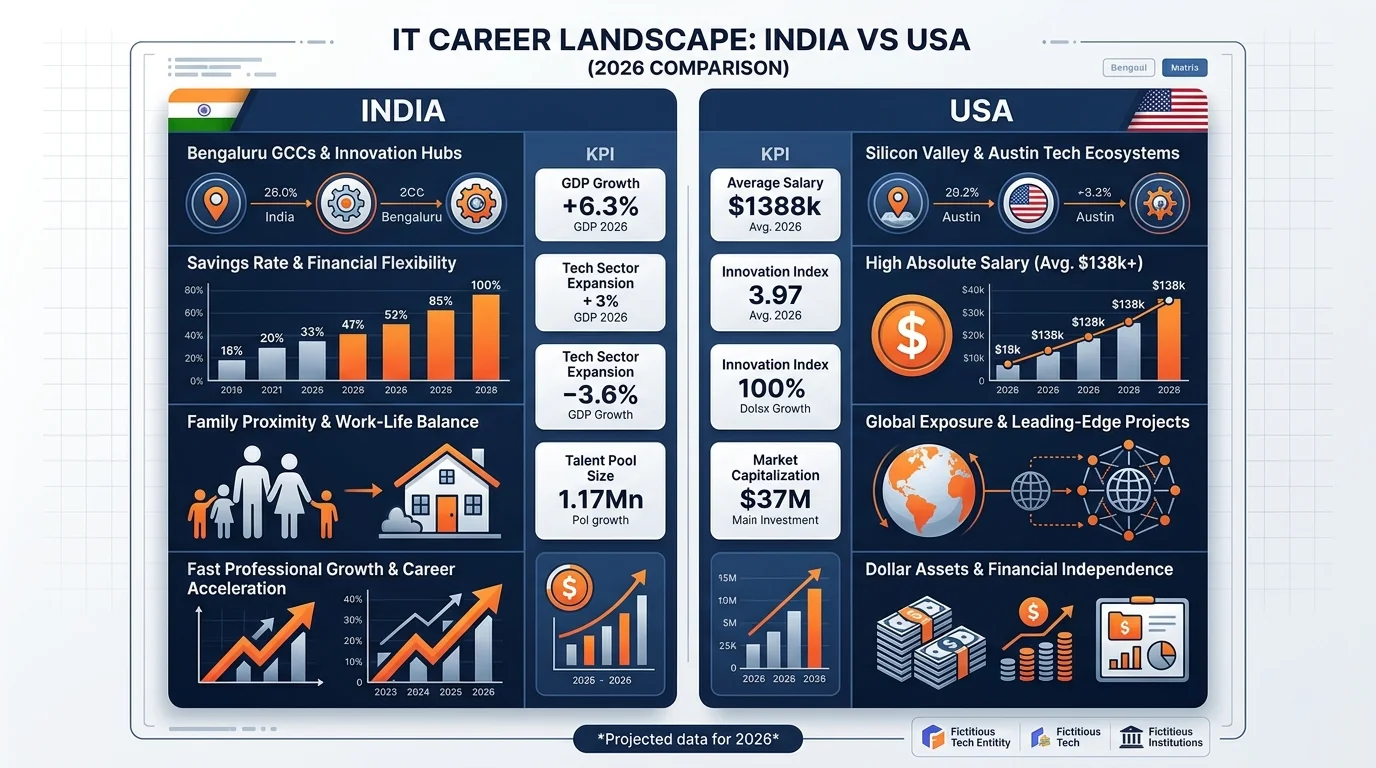
US pay is far higher in nominal terms. A 2026 comparison puts the average US software engineer base salary around $138,000, against roughly ₹14.5 lakh (about $16,500) in India. The Scaler salary guide notes the nominal multiple is often 5x to 15x at equivalent levels, before taxes and living costs narrow it.
The India range is wide
Not all Indian IT jobs pay the same. One 2026 analysis puts typical software engineer pay at ₹8 to ₹12 lakh, with senior engineers and architects earning ₹25 to ₹45 lakh. According to Kaamwork's 2026 benchmarks, product companies, funded startups and Global Capability Centers pay roughly 40 to 60% more than IT services firms at the same experience level, and big-tech offices in India can pay 3 to 5x services salaries at senior levels.
US pay is more than base
At senior levels, US offers often include large bonuses and stock. The US Bureau of Labor Statistics reported a median wage of $105,990 for computer and IT occupations in 2024, so the average software engineer figure above sits higher because it reflects developer roles specifically. For a deeper look at demand and pay, see our US IT recruitment market 2026 guide.
Take-home reality
Gross salary is a headline. Take-home pay and what it buys is the reality. Here is a simple illustration using round numbers.
| India (mid-level, Bengaluru) | USA (mid-level, e.g. Austin) | |
|---|---|---|
| Gross salary | ₹25 lakh (about $28,000) | $130,000 |
| Income tax | Roughly 13% effective under the new regime (approx.) | Federal income tax plus 7.65% payroll tax, and state tax in many states; often around 25 to 35% in total |
| Healthcare | Usually employer-provided group cover; out-of-pocket costs are lower | Employee premiums and deductibles can be significant |
| Housing | Lower share of income | Often the largest expense |
| Approx. take-home ratio to India | Roughly 3 to 4x after tax, before rent and living costs narrow it further | |
Analysts comparing Bengaluru and Austin observe that the dollar gap is around nine times, but the lived gap is much smaller, and the Bengaluru engineer often saves a higher share of net pay. The US engineer, in turn, holds dollars that travel and invest globally.
Side-by-side comparison
| Factor | India | USA |
|---|---|---|
| Absolute salary | Lower, but rising fast at product companies and GCCs | Much higher, plus bonuses and equity |
| Cost of living | Lower | Higher, especially housing and healthcare |
| Work authorization | Not an issue for citizens | Visa needed: OPT, H-1B, L-1 and others (see our H-1B 2026 update) |
| Job flexibility | Notice periods are common | Faster job changes and contract options (see C2C vs W2 vs 1099) |
| Job security | Varies; services firms can be cyclical | Employment is often at-will, so layoffs can be abrupt, but re-hiring can be quick for in-demand skills |
| Career exposure | Strong and growing | Closest to major product companies and capital |
| Family and lifestyle | Close to family and community | Distance from family, a different social setup |
Where India wins
- Savings rate: lower rent and services can let mid-career engineers save a larger share of net pay.
- No visa stress: you build your career without lottery risk or status deadlines.
- Family and support system: a real factor for long-term wellbeing.
- Rising top-end pay: product firms and GCCs increasingly pay at levels that were once US-only.
Where the USA wins
- Earning ceiling: senior and staff engineers can reach very high total compensation with bonuses and stock.
- Global career capital: US experience is valued worldwide, and dollar savings are portable.
- Depth of the market: more employers, more specialized roles, and strong demand in AI, cybersecurity and cloud.
- Contract options: C2C, W2 and 1099 arrangements give flexibility to those with the right work authorization.
The middle path: GCCs and remote US jobs
The choice is no longer only "stay" or "move." Two options sit in between:
- Global Capability Centers (GCCs) in Bengaluru, Hyderabad, Pune and other hubs let you work on global products at pay that often beats services firms.
- Remote work for US companies from India. Commentary on global remote pay suggests US-based remote roles often pay in USD at about 70 to 90% of US rates, though many companies pay less for India-based hires, so negotiate and confirm the contract type and taxes before you accept.
Analysts note the gap between a domestic senior role and a remote role for a global employer can be bigger than the gap between remote work and relocating, which is why dollar-paying remote roles are increasingly the realistic first move.
Who should choose what
| If you are... | Consider |
|---|---|
| A fresher with a US master's degree | USA via OPT and STEM OPT, with a plan for repeated H-1B attempts |
| A mid-level engineer at an IT services company | Move to a GCC or product company in India first, then reassess |
| A senior specialist (cloud, security, AI, data) | Strong options everywhere: USA via L-1 or H-1B, or remote US roles |
| Family-focused or risk-averse | India, or remote US work while staying home |
| Career-focused with a long horizon | USA, if you can secure a sustainable visa path |
60+ active direct-client requisitions. C2C, W2 and 1099 accepted.
View Open Jobs
Frequently asked questions
How much more do US software engineers earn than Indian engineers?
On paper, often 5x to 15x at similar levels. After taxes, healthcare and living costs, the practical gap is smaller and varies by company type, city and seniority.
Is it better to work in India or the USA as an IT professional?
The USA usually offers higher absolute earnings and global exposure but comes with visa uncertainty and higher living costs. India offers lower costs, family proximity and fast-growing product and GCC roles. Remote US work is a middle path.
Can I work for a US company from India?
Yes. Many US companies hire remote engineers in India, often as contractors or through employer-of-record providers. Pay is typically below US local rates but well above the Indian average.
Do GCCs pay more than IT services companies?
Generally yes. Benchmarks report roughly 40 to 60 percent higher pay at product companies, funded startups and GCCs at the same experience level.
Final thoughts
There is no universally right answer, only the right answer for your skills, risk tolerance and life stage. Compare take-home pay and savings, not headlines, and plan your visa route early if the USA is your goal. Start with our guides on the H-1B 2026 update and the US IT recruitment market, then browse open IT roles.
Sources: salaryinfo.blog, Scaler, Kaamwork, PEOrient, Abhishek Gautam (abhs.in), Sylph Corps Media, TechTarget (BLS data), Income Tax Department of India. Salary figures are approximate averages from secondary sources and exchange rates change. Verify before publishing or making financial decisions. This article is general information, not tax, legal or financial advice.